The Hidden Cost of Hand-Paving Small Asphalt Jobs
A narrow trench, short pathway or small pavement repair may not look large enough to justify a paving machine.
So the crew grabs the shovels, lutes and rakes and starts placing asphalt by hand.
That may appear to be the least expensive option, but the true cost of hand-paving asphalt is not limited to the hours shown on the job ticket. Labor, material temperature, surface consistency, rework and lost production can all turn a “small” paving job into an expensive one.
The real question is not whether the job can be paved by hand.
The question is whether hand paving is still the most profitable way to complete it.
1. Small Jobs Can Require a Surprising Amount of Labor
Hand paving involves more than unloading asphalt.
The crew must repeatedly move, distribute, rake and level the material while maintaining the required depth, grade and slope. Workers may also need to make constant corrections before compaction begins.
On a short repair, this may be manageable. Across a long utility trench, pathway, shoulder or driveway, those labor hours quickly accumulate.
A compact mini paver can mechanize much of the repetitive material placement and screeding while allowing the crew to concentrate on edges, transitions and final details.
The purpose is not to eliminate the paving crew. It is to let the crew use its time more efficiently.
2. Asphalt Does Not Stop Cooling While the Crew Works
Hot-mix asphalt has a limited working and compaction window.
Every additional minute spent shoveling, moving and manually leveling material allows the asphalt to lose temperature. As the material cools, achieving the desired density and finish can become more difficult.
This can be especially challenging when paving:
- Long utility trenches
- Narrow pathways
- Areas with numerous obstacles
- Projects located far from the asphalt plant
- Small jobs with limited crew availability
Mechanized placement helps keep material moving through the job more consistently.
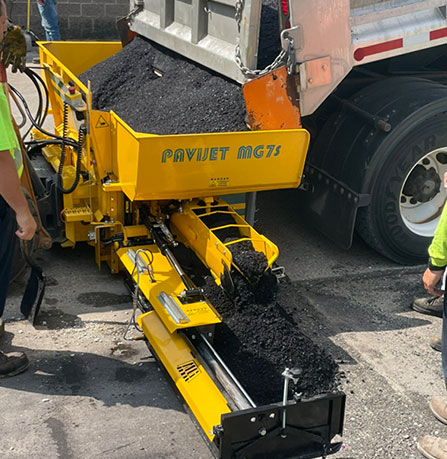
The Pavijet MG7E mini paver adds an electrically heated screed that helps prevent hot-mix asphalt from sticking to the screed during placement. Its integrated vibration system also assists with producing a smoother, more uniform mat before final rolling and compaction.
3. Maintaining Consistent Depth by Hand Is Difficult
Even an experienced crew can struggle to maintain the same material thickness across an entire hand-paved area.
A section that is too thin may not provide the required durability. A section that is too thick uses additional material and can affect the final grade.
Variations can also create:
- Low spots that collect water
- Uneven transitions
- Inconsistent compaction
- Rough surface appearance
- Premature pavement problems
A paving screed establishes a repeatable reference across the paving width. The MG7E allows operators to adjust the screed’s width, height and inclination for the application.
With paving widths ranging from approximately 12 to 78 inches, the machine can be configured for narrow repairs as well as wider paths, shoulders and pavement sections.
4. Rework Can Eliminate the Profit From a Small Job
The profit margin on a small paving project can disappear quickly if the crew must return to correct the work.
A rough finish, poor transition, incorrect slope or low area may require additional labor and material. There may also be costs associated with returning equipment to the jobsite, disrupting the customer’s property or closing the work area again.
Even when the repair does not require a callback, inconsistent results can affect the contractor’s reputation and the likelihood of receiving future work.
Mechanized paving cannot eliminate every variable. Subgrade preparation, mix quality, compaction and operator experience still matter.
However, controlling material placement with a heated, vibrating screed gives the crew a more consistent starting point than completely manual placement.
5. Hand Paving Can Limit the Number of Jobs You Accept
The largest hidden cost may be the work a contractor does not pursue.
A contractor may pass on trench restoration, bike paths, sidewalks or confined paving projects because the work requires too much hand labor. Others may price the work so high that they are no longer competitive.
A compact paving attachment can turn those difficult jobs into practical opportunities.
The Pavijet MG7E is designed to work in areas where conventional paving equipment may be too large or difficult to transport. Because it mounts to a skid steer, contractors can use a familiar carrier while adding compact paving capabilities.
Potential applications include:
- Utility-trench restoration
- Sidewalks and walkways
- Bike paths and recreational trails
- Parking-lot repairs
- Driveways and private roads
- Road shoulders and widening
- Localized pavement repairs
- Paving around fixed obstacles
[INTERNAL LINK: 7 Jobs Where the Pavijet MG7E Makes More Sense Than a Full-Size Paver]
When Does a Mini Paver Make Financial Sense?
Not every asphalt repair requires a paving attachment.
A shovel and lute will always have a place on a paving crew, particularly for very small patches, edges and areas immediately surrounding obstacles.
A mini paver begins to make financial sense when hand placement becomes the primary production method rather than a finishing method.
Consider mechanizing the work when:
- The crew regularly paves long, narrow areas
- Too many employees are tied up placing material by hand
- Maintaining a consistent width or depth is difficult
- The company frequently performs utility or municipal repairs
- Full-size paving equipment is too large for the work area
- Hand-paved jobs are creating scheduling or quality problems
- The company wants to pursue more confined-space paving work
The more frequently these conditions occur, the easier it becomes to justify a compact paving solution.
Why the MG7E?
The Pavijet MG7E combines the maneuverability of a skid steer with several features intended specifically for controlled asphalt placement:
- Electrically heated screed
- Integrated vibration system
- Adjustable paving width
- Adjustable height and inclination
- Open and closed screed configurations
- Compact design for confined areas
- Optional 50-gallon emulsion tank and spray system
These features help the crew control the paving process without bringing a conventional paver to every small or restricted job.
Stop Measuring Small Jobs by Square Footage Alone
A project can be small in size and still consume a large amount of labor.
When evaluating the cost of hand-paving asphalt, contractors should consider the complete picture: crew hours, material handling, temperature loss, surface consistency, rework and the other jobs the crew could have completed during the same time.
The goal is not to use more equipment than the job requires.
It is to use the right equipment for the work.
For narrow, confined and labor-intensive asphalt projects, the Pavijet MG7E can help contractors move more of the paving process from manual placement to controlled, repeatable production.
Make Small Paving Jobs More Productive
Contact Hitek Equipment to learn more about the Pavijet MG7E, skid-steer compatibility and available options.
Call: 262-842-1700
Email: info@askhitek.com